Your next buying step
VIAIR 300P Portable Compressor (part 30033)
Model: 300P / 30033 · US configuration
Your choices from the finder
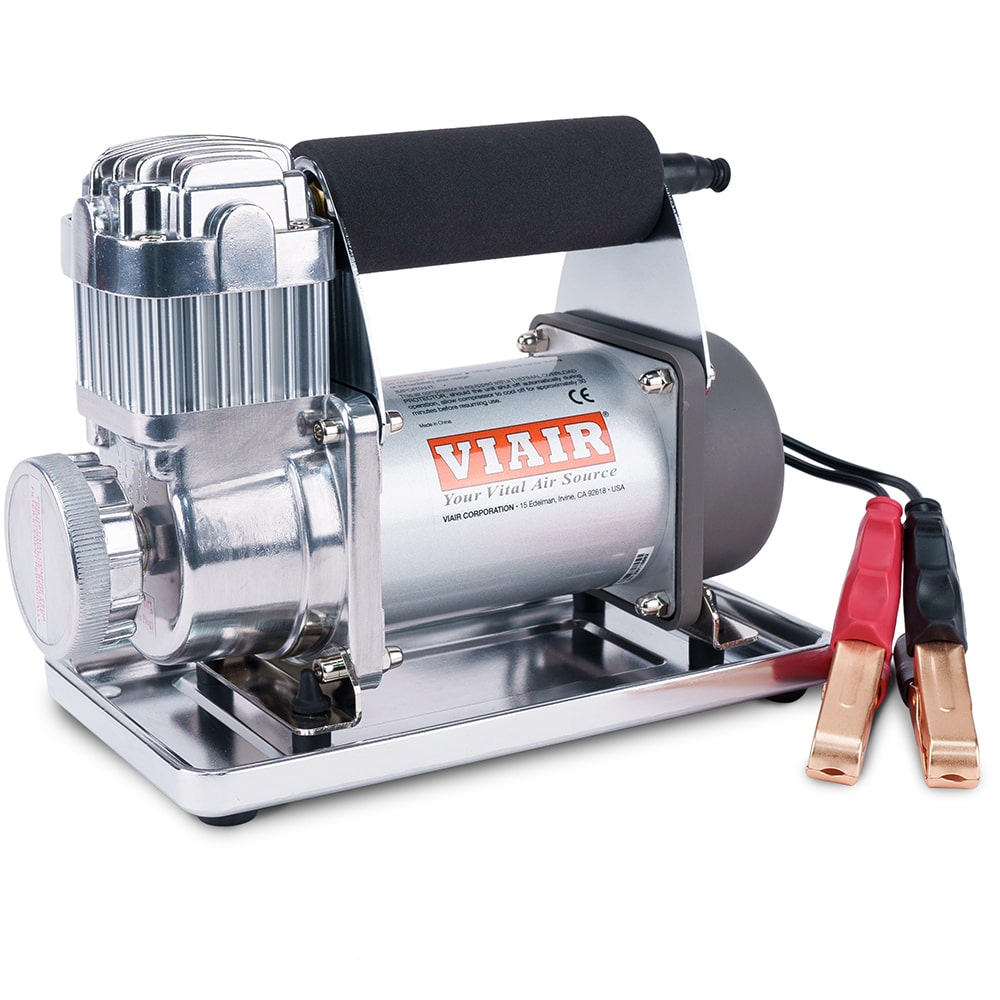
Review the product, then choose a seller
Compare offers for this model
Review the 300P / 30033 for direct-battery tire work when its 25-foot hose and manual inflator/deflator suit the vehicle setup. It is not an accessory-socket or automatic-stop inflator.
Search this model on Amazon ↗Compare the exact model, package, seller, current price and return terms. Search results can include other versions.
As an Amazon Associate I earn from qualifying purchases. This is an affiliate link.
Assessment scenario: Direct-clamp 300P tire inflation with long hose reach
An assessment scenario for a vehicle owner who can provide a suitable 12V battery-clamp connection, wants a 25-foot hose and manual inflation/deflation, and will verify the correct tire pressure and duty conditions. The 33-inch figure is VIAIR’s application reference, not an across-the-board fit guarantee.
Explore this buying guide ↗Why consider this model?
- VIAIR specifies 12V dual battery clamps and says the engine should run, aligning with a direct-battery use plan.
- The product page lists a 25-foot 5-in-1 hose with manual inflation/deflation controls and a 100-PSI gauge.
- VIAIR lists a Presta adapter for the exact kit; the reviewed operating plan documents car tires and bicycle tires with that adapter.
Tradeoffs to weigh
- The unit draws up to 30A, includes a 40A fuse and is not documented for a vehicle accessory socket.
- No preset pressure stop is documented; the manual requires the operator to switch off at the desired pressure.
- Published duty and flow figures are condition-specific and do not support a named-tire fill-time guarantee.
- The air hose needs UV, heat and cold-weather care per VIAIR’s product warning.
Check these before ordering
- Verify the exact model and part 300P / 30033, not SXS / 30032 or 300P-RVS.
- Confirm the 40A fuse holder, dual clamps, coil hose, three tips and Presta adapter are present.
- Check the vehicle’s direct-battery circuit, required fuse and engine-running instructions; do not substitute a lower-rated socket.
- Use the vehicle’s cold-pressure recommendation and review the current duty-cycle limits before repeated inflation.